Choosing Your California Home: The Insurance Question
Imagine Sarah and Tom, a couple in their late 30s, standing on a sunny balcony in Ventura County. They’re looking at a sleek condo, a perfect fit for their busy lives. Just last week, they were touring a charming single-family home in the same neighborhood, a place with a small backyard and a bit more space. Both options felt right, but one big question kept popping up: *What about the insurance?*
They aren’t alone. For many Californians, deciding between a house and a condo isn’t just about space or price. It’s also about figuring out what you’re actually insuring. You see, the Golden State’s housing market is a beast, and its insurance market? That’s another beast entirely, especially with recent wildfires, mudslides, and insurers like State Farm and Farmers adjusting their coverage. The short answer is yes, both homes and condos need insurance. The real answer is more complicated, because what each policy protects couldn’t be more different.
The Big Picture: What You Own, What You Insure
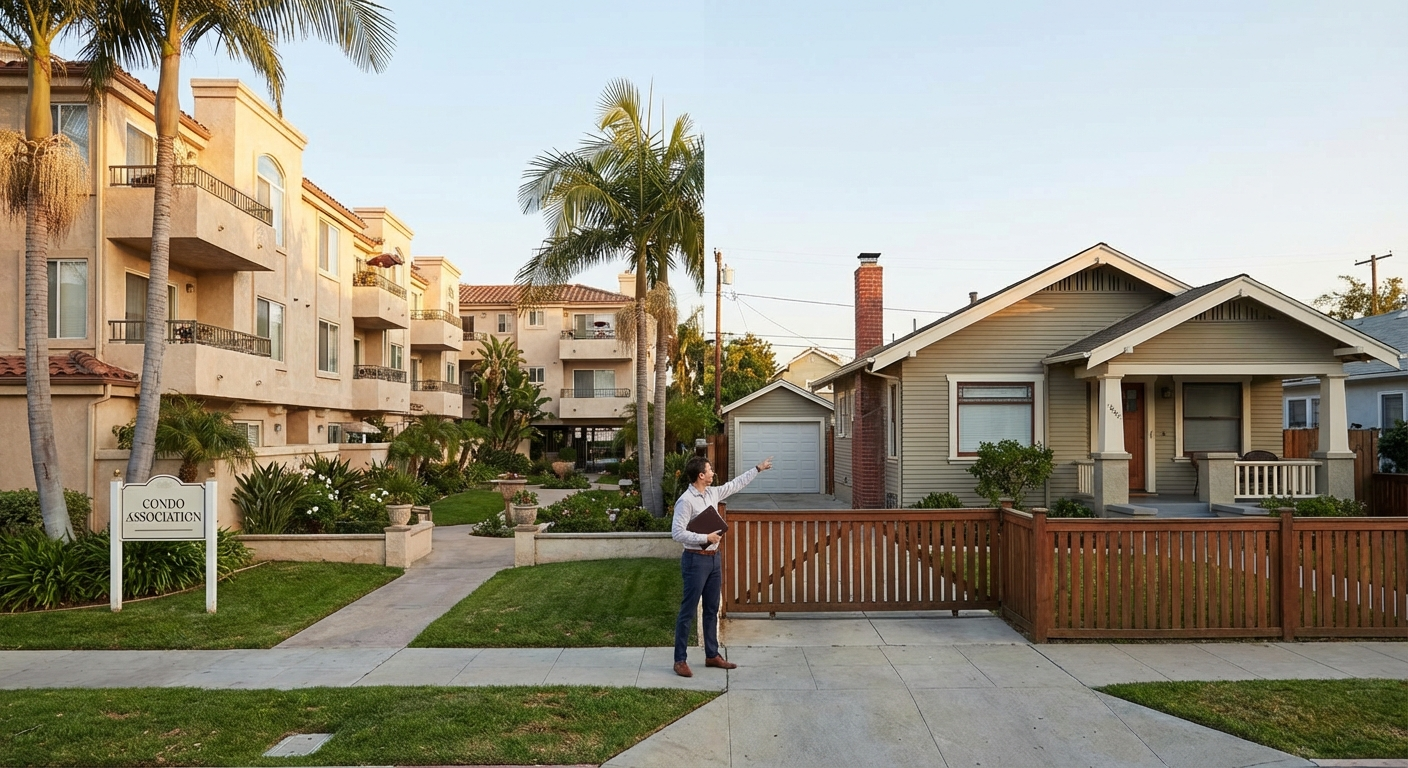
At its heart, the difference between homeowners insurance and condo insurance boils down to property lines. When you buy a house, you own the entire structure — the roof, the foundation, all the walls, the land it sits on. It’s all yours. So, your homeowners insurance policy, often called an HO-3 or sometimes an HO-5 for broader coverage, has to protect all of that.
But here’s where it gets interesting. With a condo, you own the interior of your specific unit. Maybe it’s from the “paint in,” meaning everything from the drywall to your appliances and personal belongings. The building itself — the roof, the exterior walls, the shared hallways, the swimming pool, the gym — that’s typically owned collectively by all the unit owners, managed by the Homeowners Association (HOA). This fundamental distinction shapes everything about your insurance needs.

Homeowners Insurance: Protecting Your Entire Kingdom
Think about a typical house in the Valley. If a tree falls on the roof during a winter storm, or if a kitchen fire — heaven forbid — forces you out for months, your homeowners insurance is designed to step in.
An HO-3 policy, the most common type, usually covers a few key areas:
* **Dwelling Coverage:** This is for the structure of your home itself. If a fire rips through your kitchen, or a strong wind damages your roof, this is the part of your policy that pays to rebuild or repair. Calculating this correctly is huge, especially with the rising construction costs we’ve seen in places like the Inland Empire. You don’t want to be underinsured if a 2025 LA fire sweeps through your neighborhood.
* **Other Structures:** Your detached garage, your backyard shed, that fancy fence you just put up? Those are covered here.
* **Personal Property:** All your stuff inside the house — furniture, clothes, electronics, jewelry (up to certain limits, sometimes requiring extra coverage). If a burglar breaks in or a pipe bursts and ruins your living room set, this coverage helps replace those items.
* **Loss of Use (Additional Living Expenses):** If your home becomes uninhabitable after a covered disaster, like that kitchen fire, this helps pay for temporary housing, meals, and other necessary expenses while your home is being repaired. Sarah and Tom, looking at that house, would definitely want to consider this.
* **Personal Liability:** Let’s say a guest slips on your wet patio and breaks an arm. This coverage helps pay for their medical bills and any legal fees if they decide to sue you.
That’s not the whole story for California homeowners. Earthquake damage? Nope, that’s almost always a separate policy you’d buy. Flooding from a river overflowing its banks? Also separate. And with many traditional insurers pulling back or raising rates dramatically in high-risk wildfire areas, like parts of Malibu or the Sierra foothills, some homeowners are finding themselves on the California FAIR Plan — an insurer of last resort — which often offers less coverage and can be more expensive. It’s a tough market out there right now.
Condo Insurance: Covering Your Inner Sanctum
Now, let’s go back to Sarah and Tom on that Ventura County condo balcony. If they buy that unit, their insurance needs look quite different. They’ll need an HO-6 policy, specifically designed for condo owners.
Here’s why: the HOA has its own master insurance policy for the entire building. But what that master policy covers varies wildly, and that’s the first thing you need to understand when looking at condo insurance. There are usually three types of master policies:
* **”Bare Walls-In” or “Walls-Out”:** This is the most basic. The HOA’s policy covers the building’s structure, common areas, and exterior. *Your* HO-6 policy would need to cover everything inside your unit, starting from the studs — the drywall, flooring, fixtures, cabinets, appliances, and all your personal belongings. It’s a lot to cover.
* **”Single Entity” or “Original Specifications”:** This is a bit better. The HOA policy covers the building structure, common areas, and the original fixtures within your unit. So, if your condo came with standard cabinets and countertops, the master policy might cover those if damaged. But any upgrades you’ve made? Your HO-6 would need to cover them.
* **”All-In” or “All-Inclusive”:** This is the most generous. The HOA policy covers the structure, common areas, and *all* fixtures and improvements within your unit, even upgrades. Your HO-6 would mainly focus on your personal belongings and liability. This type of master policy is less common, but it’s a nice surprise when you find it.
So, what does an HO-6 policy usually cover for *you*?
* **Interior Unit Coverage:** Depending on the master policy, this pays to repair or replace the interior of your unit — think walls, floors, ceilings, cabinets, built-in appliances. This is where the “bare walls” vs. “all-in” distinction becomes absolutely critical.
* **Personal Property:** Just like homeowners insurance, this protects your furniture, clothes, electronics, and other belongings.
* **Loss of Use:** If a fire in your unit or a flood from an upstairs neighbor forces you out, this helps pay for your temporary living expenses.
* **Personal Liability:** If someone gets hurt inside your condo, or if you accidentally cause damage to a neighbor’s unit (say, your washing machine overflows), this coverage kicks in.
* **Loss Assessment:** This is a big one for condo owners. If the HOA’s master policy has a high deductible — maybe $50,000 or $100,000 for a major building repair — or if a covered loss exceeds the master policy’s limits, the HOA can “assess” each unit owner a portion of that cost. Your HO-6 loss assessment coverage helps pay for your share. Imagine an earthquake (again, separate policy for the building, but if the HOA policy has a huge deductible for quake damage) or a building-wide fire; those assessments can be steep.
Which Brings Up Something Most People Miss: The HOA Master Policy
Understanding the HOA’s master policy isn’t just “important to note,” it’s absolutely essential. You can’t adequately insure your condo without knowing what the HOA already covers. Seriously. When Sarah and Tom get serious about a condo, their agent will ask for a copy of the master policy and its declarations page. This document tells them exactly where the HOA’s coverage stops and their personal HO-6 coverage needs to begin. Without it, you’re guessing, and that’s a dangerous game in California’s insurance market.
Cost Factors and the California Reality
Honestly, predicting insurance costs is like predicting traffic on the 405 — impossible to get exactly right, but you can see the trends. For both homeowners and condo owners, premiums are driven by several factors:
* **Location:** Living in a high wildfire zone (parts of Napa, Shasta County), a coastal flood zone, or an area with significant earthquake risk (most of the state, frankly) will affect your rates.
* **Reconstruction Costs:** The cost to rebuild your home or unit. This has jumped significantly in recent years.
* **Claims History:** Your personal claims history, and sometimes the claims history of your HOA or even the entire neighborhood.
* **Deductibles:** Opting for a higher deductible usually means a lower premium.
* **California’s Market:** Insurers have been struggling here, leading to non-renewals and higher rates across the board. The state’s Department of Insurance, under Prop 103, is working on reforms, but changes take time.
For Karl Susman of Condo Insurance California, CA License #OB75129, getting the right fit isn’t just about price. “You don’t want to save a few bucks on your premium only to find out you’re massively underinsured after a fire,” he often says. “Especially for condo owners, the details of that HOA master policy are everything.”
Making the Right Choice: Talk to a Pro
Whether you’re Sarah and Tom weighing a house vs. a condo, or you’re already a California homeowner or condo owner wondering if your policy is still adequate in this volatile market, getting expert advice is non-negotiable. An experienced independent agent can look at your specific situation, your property’s unique risks, and help you understand the nuances of what’s covered — and what isn’t. They can compare options from various insurers, explain those tricky HOA master policies, and make sure you’re protected.
Don’t guess when it comes to protecting your most valuable asset. Get a personalized quote today and understand your options. Visit https://condoinsurancecalifornia.com/quote/ to start the process.
It’s about peace of mind. You want to know that if disaster strikes, whether it’s a small leak or a major event, you have the right coverage in place. Understanding the differences between condo and homeowners insurance is the first step toward that security.
Ready to get a quote tailored to your California home, whether it’s a house or a condo? Click here: https://condoinsurancecalifornia.com/quote/
Frequently Asked Questions
What is loss assessment coverage for condos?
Loss assessment coverage is a specific part of your HO-6 condo insurance policy. It protects you if your Homeowners Association (HOA) charges you a special assessment for a covered loss that exceeds the HOA’s master insurance policy limits or deductible. For example, if a major fire causes $500,000 in damage to the building, but the HOA’s policy only covers $400,000, the remaining $100,000 might be divided among unit owners. Loss assessment coverage would help pay your share.
Do I need earthquake insurance for my condo or house in California?
In California, standard homeowners and condo insurance policies almost never cover earthquake damage. You need to purchase a separate earthquake insurance policy, often through the California Earthquake Authority (CEA) or a private insurer. Given California’s seismic activity, it’s something every homeowner and condo owner should consider, even if it adds to your overall insurance cost.
My HOA has a master insurance policy. Why do I need my own condo insurance?
Even with an HOA master policy, you absolutely need your own HO-6 condo insurance. The HOA’s policy typically covers the building’s exterior, common areas, and sometimes the original interior fixtures, but it won’t cover your personal belongings (furniture, clothes, electronics). It also might not cover the interior of your unit if the master policy is “bare walls-in,” and it definitely won’t cover your personal liability if someone is injured inside your unit.
What happens if my insurer non-renews my policy in California?
If your insurer decides not to renew your homeowners or condo policy in California, you’ll need to find new coverage. This is becoming more common, especially in areas prone to wildfires. You can try other traditional insurers, but if you’re in a high-risk zone, you might need to turn to the California FAIR Plan, which is the state’s “insurer of last resort.” An independent agent like Karl Susman at Condo Insurance California can help you explore your options if you face a non-renewal.
This article is for informational purposes only and does not constitute financial advice.
CA License #OB75129
Phone: (877) 411-5200
Karl Susman, Condo Insurance California