Myth: My HOA’s Insurance Policy Covers Everything in My Condo. Right?
Honestly, this is one of the biggest misunderstandings among California condo owners. Many folks buy a unit, get excited about the pool or the shared gym, and figure the homeowners association (HOA) handles all the insurance stuff. Sounds easy enough, doesn’t it? The short answer is yes, they do handle *some* of it. The real answer is far more complicated, and missing the nuances could leave you seriously exposed after a fire, a flood, or even just a burst pipe.
Think about it: Your HOA’s master policy is designed to protect the collective, not necessarily your individual unit’s interior or your personal belongings. It’s a common area protector, a structural shield. But what happens inside your walls? That’s usually on you.
The Master Policy: What It Actually Protects (and Doesn’t)
Every condo association in places like Orange County, the Inland Empire, or even up in the Bay Area, has a master insurance policy. This policy is a big deal. It covers the shared property — things like the building’s exterior, the roof, stairwells, swimming pools, clubhouses, and the land itself. It’s the insurance that kicks in if, say, a major earthquake hits and cracks the foundation, or a wildfire tears through a Ventura County complex.
But here’s where it gets interesting. Not all master policies are built the same. There are generally two main types you’ll find:
Bare Walls-In Coverage
This is the most common type, and frankly, it leaves the biggest gap for unit owners. With “bare walls-in” or “studs-out” coverage, the master policy literally covers the building up to the drywall. Imagine your condo as an empty shell. The HOA policy protects the studs, the plumbing pipes *within the walls*, electrical wiring *within the walls*, and the exterior.
What’s missing? Everything you see and touch once you step inside your unit. We’re talking about your flooring, cabinets, countertops, light fixtures, appliances, internal paint, even the drywall itself. If a fire starts in your kitchen and burns through your cabinets and ruins your new hardwood floors, the HOA’s bare walls policy won’t pay to replace those. That’s a huge expense.
All-In (or All-Original) Coverage
Sometimes called “single entity” coverage, this type is more generous. An “all-in” master policy covers the structure of the building *and* the original fixtures inside your unit. So, if your condo came with builder-grade cabinets and standard carpeting, an all-in policy would cover those if they were damaged.
But wait — there’s still a catch. If you upgraded your kitchen with custom cabinetry, granite counters, or installed expensive engineered wood flooring, an “all-in” policy typically won’t cover those *upgrades*. It only covers the *original* installed items. So, while it’s better than bare walls, it still leaves a potential hole for anyone who’s personalized their space.

Your Individual Policy: The HO-6 is Your Best Friend
If the master policy covers the bones of the building, your individual condo insurance policy — known as an HO-6 policy — is what protects your personal world. It’s designed to fill those exact gaps left by the HOA’s coverage.
Think about what an HO-6 policy actually does for you:
* **Interior Coverage (Dwelling/Improvements & Betterments):** This is where you cover your floors, cabinets, countertops, paint, light fixtures, and any other permanent fixtures inside your unit. If you have a bare walls master policy, this part of your HO-6 is absolutely critical. Even with an all-in policy, this is where you’d cover your upgrades.
* **Personal Property:** Your clothes, furniture, electronics, artwork, dishes, books — everything that would fall out if you turned your condo upside down. This is the stuff that makes your condo *yours*. Without an HO-6, none of it is covered if a fire or theft occurs.
* **Personal Liability:** This is huge. If someone gets hurt inside your unit — maybe they slip on a wet floor or trip over your rug — your HO-6 policy can cover their medical bills and any legal defense costs if they sue you. The HOA’s master policy won’t protect you from a lawsuit stemming from an incident *inside your personal unit*.
* **Loss of Use (Additional Living Expenses):** What if a fire or flood makes your condo unlivable for months? Where do you stay? An HO-6 policy can cover temporary housing, food, and other increased living expenses while your unit is being repaired.
* **Loss Assessment Coverage:** This is a tricky one, and it’s something most people miss. If the HOA’s master policy has a high deductible — say, $25,000 or even $50,000, which is common in California now with the rising costs of property insurance — and a covered event occurs, the HOA can “assess” that deductible back to the unit owners. If there are 100 units, that $50,000 deductible could mean a $500 bill for you, even if your unit wasn’t directly damaged. Your HO-6 policy can cover these assessments, up to your chosen limit.
California’s Unique Insurance Challenges
Living in California, especially in places like Los Angeles or parts of San Diego County, means dealing with specific risks. Wildfires are a constant threat. Earthquakes are always a possibility. These realities have made property insurance a real headache for HOAs and individual homeowners alike.
Many insurers, like State Farm, AAA, and Farmers, have pulled back or restricted coverage in high-risk areas. This means HOAs are facing massive premium increases — sometimes premiums jumped 40% between 2022 and 2024 — or they’re forced into the California FAIR Plan, which offers basic fire coverage but often at higher prices and with more limited options.
When an HOA’s master policy costs skyrocket, they often pass those costs directly to unit owners through higher monthly dues or special assessments. This also means HOAs might opt for higher deductibles on their master policies to keep premiums somewhat manageable. That’s why loss assessment coverage on your HO-6 is more important than ever.
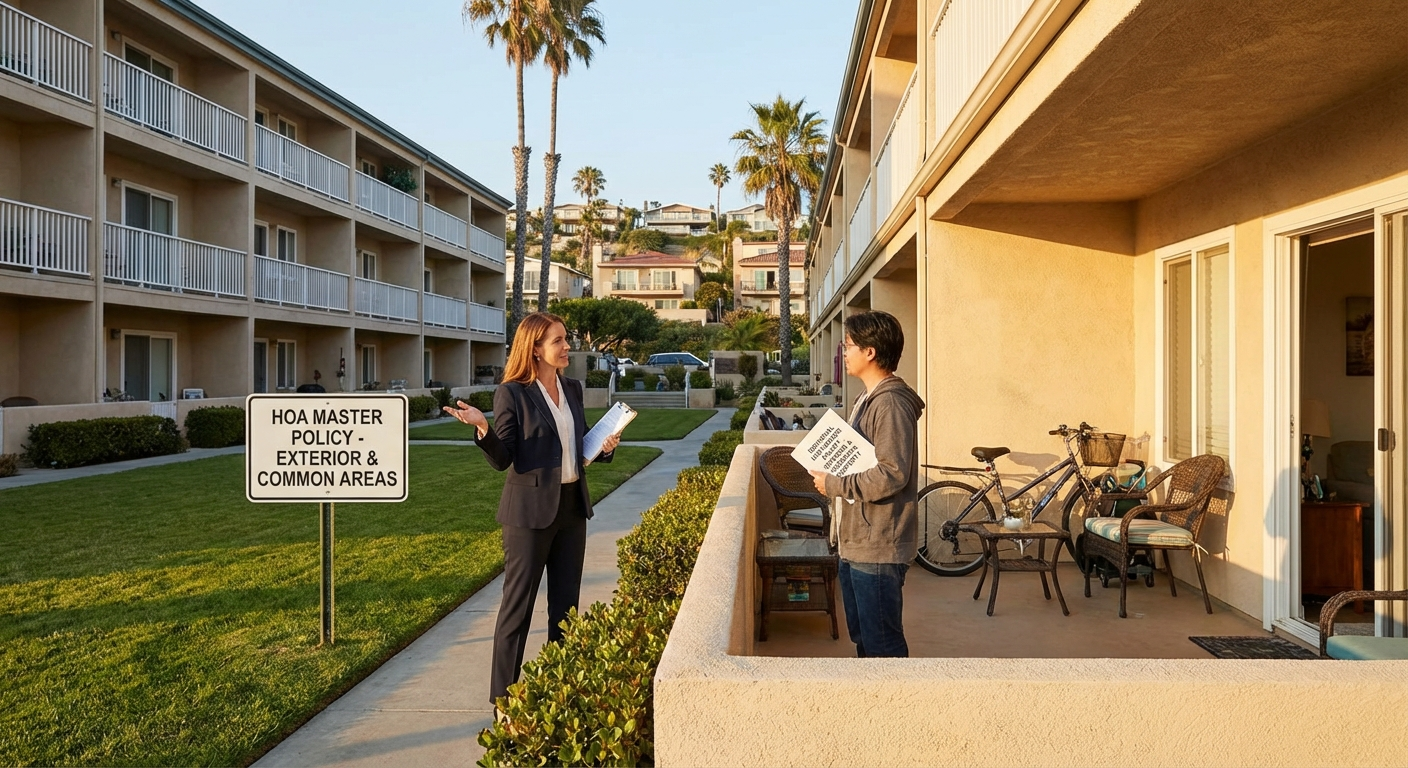
Navigating Deductibles and Assessments
Let’s say a pipe bursts in a common wall, damaging your unit and a neighbor’s. The HOA’s master policy will likely cover the common wall and structural repairs, but the deductible could be substantial. If that deductible is $25,000, and the HOA’s governing documents allow it, that amount could be split among all unit owners.
Your HO-6 policy’s loss assessment coverage steps in here. It’s not just for property damage, either. If the HOA gets sued for an accident in a common area and the master policy’s liability limits aren’t enough, the excess could be assessed to owners. Your HO-6 can help cover that, too.
This isn’t just theory. We’ve seen situations in communities across the Valley and coastal areas where a single incident has led to five-figure assessments for individual owners who thought they were fully covered.
Finding the Right Fit for Your Condo
Honestly, understanding the specific details of your HOA’s master policy is the first step. Ask for a copy of their Certificate of Insurance and the declarations page. Look for whether it’s “bare walls” or “all-in.” This information is absolutely critical for Karl Susman and his team at Condo Insurance California, CA License #OB75129, to help you craft an HO-6 policy that truly protects you.
It’s not about just getting *any* policy. It’s about getting the *right* policy. One that plugs the specific holes in your HOA’s coverage. One that accounts for your upgrades, your personal belongings, and the unique risks of living in California.
Don’t leave your biggest investment vulnerable. It’s too important. To find out exactly what kind of coverage you need for your California condo, get a personalized quote today.
Click here to get your personalized condo insurance quote!
Many people think they’re set because they pay HOA dues. But those dues mostly cover the HOA’s policy and maintenance. Your personal policy is your financial safety net.
When you’re comparing policies, don’t just look at the premium. Consider the deductibles, the coverage limits, and what’s included for personal property and loss assessment. A slightly higher premium could mean vastly better protection when you actually need it.
For personalized guidance and to ensure you’re not caught off guard by California’s complex insurance environment, talking to an expert like Karl Susman at Condo Insurance California, CA License #OB75129, is a smart move. You can reach them at (877) 411-5200.
Get a tailored condo insurance quote now – protect your home and your peace of mind.
—
Frequently Asked Questions About Condo Insurance in California
Q: Do I really need an HO-6 policy if my HOA has an “all-in” master policy?
Yes, absolutely. Even with an “all-in” master policy, your HO-6 covers your personal belongings, any upgrades you’ve made to your unit beyond the original builder-grade finishes, personal liability if someone is injured in your unit, and loss assessment coverage for shared deductibles or lawsuits against the HOA. The master policy protects the building’s original components; your HO-6 protects *your* stuff and *your* liability.
Q: What is “loss assessment coverage” and why is it so important in California?
Loss assessment coverage protects you from having to pay out-of-pocket for your share of a large deductible or uninsured loss that the HOA passes on to unit owners. In California, master policy deductibles are often very high (tens of thousands of dollars) due to wildfire and earthquake risks. If a major incident occurs, the HOA might assess a portion of that deductible to each unit owner. Your HO-6’s loss assessment coverage can pay for this, saving you a significant sum.
Q: My HOA fees include insurance. Isn’t that enough?
No, not by a long shot. While your HOA fees do contribute to the cost of the master policy, that policy covers the common areas and the building’s structure, not your individual unit’s interior, your personal property, or your personal liability. Thinking your HOA fees cover everything is a common and potentially very expensive mistake.
Q: Can my individual condo insurance cover earthquake damage?
Standard HO-6 policies typically do not include earthquake coverage. However, you can usually add earthquake coverage as an endorsement to your HO-6 policy or purchase a separate earthquake policy through a provider like the California Earthquake Authority (CEA). Given California’s seismic activity, it’s definitely something to consider.
—
This article is for informational purposes only and does not constitute financial advice.